What Documents Do I Need To Get A Self-Employed Mortgage?

Save time and ensure your mortgage application proceeds smoothly by collecting all relevant documentation in advance.

How Much Can I Borrow?
Get an indicative figure in 60 seconds. No opt-in required.
Rated Excellent 5/5
Five stars
on

Company Director? Read This First...

3 Costly Mistakes Company Directors Must Avoid Before Applying For A Mortgage

A 5 minute read that could save you thousands of pounds

Ebook cover - 3 costly mistakes company directors must avoid before applying for a mortgage
Graham Cox - Founder & Cemap Mortgage Advisor | SelfEmployedMortgageHub.com
Graham Cox
CeMAP Mortgage & CPSP Specialist Finance Adviser

Before starting the process of applying for a mortgage, it's vitally important your adviser has access to all the relevant paperwork.

Not only will it allow them to fully understand your circumstances and seek clarification where required, but it means you'll receive your mortgage offer more quickly as well.

With that in mind, we've put together this handy self-employed mortgage documentation guide. We recommend you bookmark it for easy access.

Income proof for a self-employed mortgage

The documents you'll need depend on your business structure, trading history, and the mortgage lender you're applying to.

Most lenders want evidence of your historical self-employed income, although the number of years required and the documents accepted vary between providers. Some lenders will consider applicants with just one year's accounts or trading history.

Your mortgage adviser may also ask for additional documentation before recommending a lender, particularly where your income has changed significantly or your business has a short trading history.

Standard documentation to verify income

Lenders require the following documents for the last two trading years if you've been trading that long. If not, for your first year:

Limited company directors will also need to provide latest payslip if registered for PAYE through their business, and their HMRC submitted statutory company financial accounts, produced by a qualified accountant* for the relevant period(s).

The company accounts must show the:

  • Balance sheet
  • Profit and Loss statement
  • Notes to the accounts.

Please note filleted accounts are not accepted by mortgage providers.

*If you don't use an accountant, let us know so we can advise you.

Accountant's certificates

A few lenders accept an accountant's certificate, either to supplement the above documents or more often, in lieu of them.  

The certificate is a form provided by the lender and signed by your accountant verifying business turnover, gross and net profit before tax for sole traders, and post-tax profit, salary and dividends for directors.

Your accountant may also be asked to provide a projection for the current year's trading to provide comfort to the lender that profitability is sustainable.

Documentation to provide if you're a contractor

In addition to supplying the documents above (where applicable). lenders will want to view a contractors current contract. If the contract has renewed, they may request the applicant's previous one too.

If your earnings are high enough, and/or you fit the lenders other criteria, it's often possible to be treated as employed for income assessment. In which case, your contract and bank statements alone can be sufficient to evidence your income.

If you contract through an umbrella company, lenders typically require a copy of your latest contract and P60.

What's an SA302?

An SA302 is an official tax calculation document produced by HMRC after you submit your personal tax return (SA100).

Aside from showing how much tax you owe, the SA302 summarises your declared earnings for the tax year, including pre-tax profits for sole traders, and salary and dividends for company directors.

Other income streams such as investments or rent are also included.

How do I get my SA302?

If your accountant uses commercial accounting software to submit your self-assessment tax return, they should provide you with the tax calculation, or tax computation as it's also known.

This is essentially an unofficial version of the HMRC's SA302 tax calculation, but it's widely accepted by lenders for mortgage purposes.

Even though they are not strictly the same thing, you'll often see the terms SA302 and tax calculation/computation used interchangeably. The latter is often, but not always, referring to the accountant supplied version. Rule of thumb: if you have an accountant, ask them to provide your tax calculation.

If you or your accountant filed your tax return directly via HMRC Online, your SA302 should be ready to print as a pdf file 72 hours later.

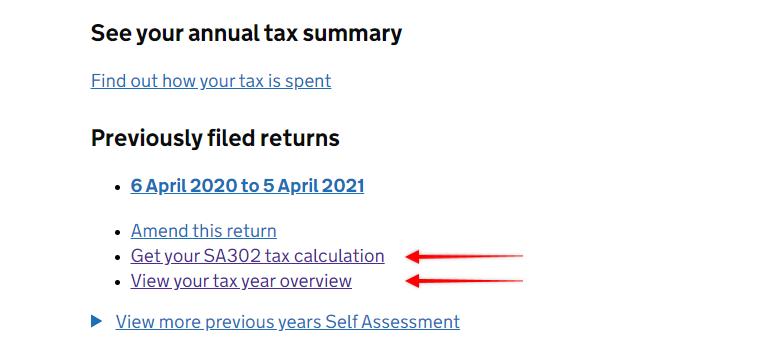
To print your SA302:

  • Sign into your HMRC Login account
  • Go to 'Self Assessment'
  • Scroll down the page to 'Previously filed returns'
  • Click Get your SA302 tax calculation
  • Select the SA302 for the relevant year
  • Select 'Save as PDF' and click Save
Image showing where to view and print SA302 tax calculation and Tax Year Overview documents
Inside your HMRC Online portal

What's a Tax Year Overview?

The Tax Year Overview (TYO), or Tax Overview as it's sometimes called, is a document produced by the HMRC. It verifies the figures in your SA302 are correct, and shows the tax to be paid by yourself or refunded by HMRC.

The SA302/tax calculation and TYO go hand in hand, and for mortgage purposes, most lenders will want to see both documents for the relevant year(s).

How do I get my Tax Year Overview?

Downloading your TYO documents from HMRC is very similar to how you accessed your SA302s.

To print your Tax Year Overview:

  • Sign into your HMRC Login account
  • Go to 'Self Assessment'
  • Scroll down the page to 'Previously filed returns'
  • Click 'view your tax year overview'
  • Choose the year from the 'Tax year ending' dropdown menu and click Go
  • Click 'Print your tax year overview'
  • Select 'Save as PDF' and click Save

Book a call at a time to suit you!

"Brilliant from start to finish. Graham managed to find a main high street lender who offered a brilliant rate. Would highly recommend."

Tracy Boyle - Google Business Review
Book an adviser Call
Book a call back at time to suit you.
Schedule a call in 60 seconds.

Verifying your identity and address

As you'd expect, proving your identity and address is a mandatory requirement to get a mortgage. Fortunately, it's very straightforward:

Identification documents

All mortgage lenders must verify your identity, although the way this is done varies between providers.  Some use electronic identity verification, while others request copies of identification documents.

Depending on the lender and application process, you may be asked to provide a:

  1. Full, in date, UK photocard driving license or...
  2. Valid UK passport, showing your photograph, name, expiry date and passport number

Nearly every mortgage lender will need your National Insurance number. If you don't know it, check your:

  • latest payslip
  • P60 (aka End of Year Certificate)
  • Personal online tax account. Alternatively, as a last resort, contact HMRC.

Address documents

As long as it's dated within the last 3 months, the most recent copy of one of the following is usually acceptable as long as it clearly shows your name(s) and current home address:

  1. Bank statement (all pages of the latest months statement , not just the front page)
  2. Council Tax statement
  3. Utility bill

How do I certify my ID documents?

Some lenders require certified copies of your proof of identity and proof of address.

Your local post office or a solicitor can certify your ID and address documents. If you're making a joint application, both of you must attend so they can verify your ID.

Documents to prove your current trading performance

Even though your company accounts and SA302/tax calculation evidences historical profitability and earnings, lenders will want to be satisfy themselves that current trading performance is not deteriorating. If it's actually improving, so much the better.

Download your latest 3 months business bank statements

We recommend downloading the three most recent months business bank account statements. The latest statement should be dated within 30 days of the mortgage application submission date.

Management accounts and financial projections

To assess the sustainability of your business going forward, your accountant may be contacted directly by the bank or building society requesting further financial information about your business.

This can take the form of the aformentioned accountant's certificate, management accounts for the current trading year to date and/or a signed letter answering the lender's queries.

The most common scenario for a lender to contact an accountant is where profits have increased significantly in the latest trading year, and they wish to confirm they are sustainable going forward.

Book a call at a time to suit you!

"Brilliant from start to finish. Graham managed to find a main high street lender who offered a brilliant rate. Would highly recommend."

Tracy Boyle - Google Business Review
Book an adviser Call
Book a call back at time to suit you.
Schedule a call in 60 seconds.

Evidence of current personal income & expenditure

Each lender will have their own requirements, but your three most recent current account bank statements is usually sufficient.

Lenders check these thoroughly to ensure there are no hidden surprises that could render the mortgage unaffordable. For example, non-credit financial commitments such as school fees, ex-spousal support or child maintenance.

Proof of deposit

All lenders require proof you have sufficient finance in place to pay the deposit.

What constitutes an acceptable deposit source depends on the lender, but the most common are:

  • Personal savings in a bank account
  • Investments such as an ISA, or Premium Bonds
  • An inheritance
  • Liquidated funds from a property sale
  • A gifted deposit from a family member

A pdf statement from your personal current bank or investment account is normally sufficient proof.

Non-UK nationals: evidence of immigration and residency status

If you're not a British or Irish citizen, the lender may need evidence of your immigration status and right to reside in the UK.

Many applicants now have an eVisa, which is a digital record of their UK immigration status. You can access your eVisa by signing into your UKVI account and, where required by the lender, generate a share code that allows your immigration status to be checked.

The mortgage options available can depend on factors including your visa or immigration status, how long you've lived in the UK, your remaining leave, income, deposit and the individual lender's criteria.

You don't necessarily need indefinite leave to remain to get a UK mortgage. Some lenders will consider applicants with time-limited visas or other eligible immigration statuses, subject to their lending criteria.

Irish citizens generally have separate rights under the Common Travel Area and don't normally require permission to enter or remain in the UK.

Got questions or need help?

If you need help with collating your mortgage documentation, or need clarification on anything, please contact your SEMH mortgage adviser who will be happy to help. Or call 0117 205 0655 during our office hours of 9am - 5pm Monday - Friday or email us here.

Graham Cox - CeMAP Mortgage & CPSP Specialist Finance Adviser

About the author

Graham Cox is the founder of SelfEmployedMortgageHub.com or SEMH for short.

Based in Gloucestershire, SEMH is an independent, whole of market broker and a true specialist in self-employed mortgages, helping business owners across the UK get great mortgage and protection deals.

Graham's market commentary and analysis is regularly quoted in the national press and media, including The Guardian, Telegraph, FT Adviser, and BBC Radio Bristol.